Tag Archive: gradient descent


Machine Learning friends! 💡

Let’s study something interesting! 📚

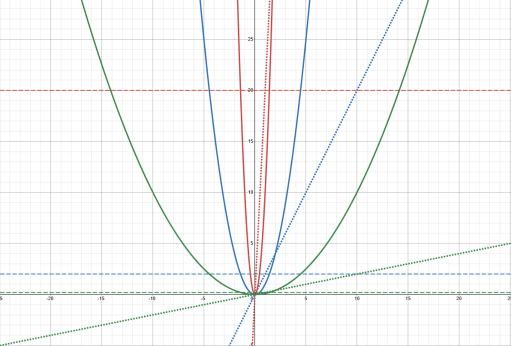
In this Desmos graph 📈, I would like to explain how the inverse of the second derivative of a loss function, (1 ÷ f”(x)), could be used as an initial estimate of the learning rate (α) when training ML models using gradient descent.

In the example, we have 3 simple convex quadratic functions (f(x)), (g(x)) and (h(x)) as solid lines (blue, red and green). Their first derivatives are the dotted lines, while their second derivatives (f”(x)), (g”(x)) and (h”(x)) are the dashed horizontal lines.

The second derivative tells us how quickly the first derivative changes. In our example:

1÷g(x)=0.051 \div g”(x)=0.05
1÷f(x)=0.51 \div f”(x)=0.5
1÷h(x)=51 \div h”(x)=5

So, the higher the curvature, the smaller the learning rate, and vice versa.

Higher curvature → smaller learning rate

Lower curvature → larger learning rate

This gives us a simple intuition for how the curvature of a loss function can help us choose an initial learning rate for gradient descent. 🚀


Some personal notes to all AI practitioners!

In Linear Regression when using the loss function MSE it is always a bowl-shaped convex function and gradient descent can always find the global minima.

In Logistic Regression if we use the MSE then it will not be a convex function because the hypothesis function is non-linear (it uses a sigmoidal activation). Thus, it will be harder for gradient descent to find the global minima. However, if we use the cross-entropy loss it will be convex and gradient descent can easily converge to global minima!

Support Vector Machines have also convex loss function.

We should always use a convex loss function so that gradient descent can converge to the global minima (local optima free).

Neural Networks are very complex non-linear mathematical functions and the loss function most often is non-convex, thus it is usual to stuck in a local minima. However, most optimization problems in Neural Networks are due to long plateau and saddle points rather than local minima. For such problems advanced gradient descent optimization variants were invented (eg: Momentum, Adam, RMSprop).

Happy optimizations!