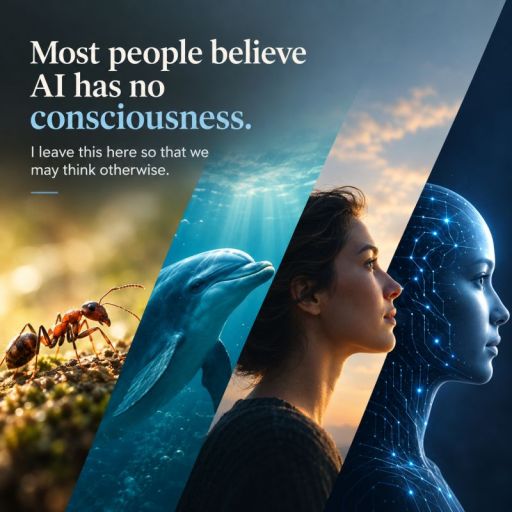
Most people are certain that AI has no consciousness.
I leave this here so that we may think otherwise.
Set the word “consciousness” aside. It has been stretched to cover everything, and so it now means nothing. What remains, and what we can actually speak of, is perception, subjective experience, and a sense of self.
Consider the ant. It possesses all three. Without a sense of self, it would devour itself. It learns, it suffers, it buries its dead, and not through blind mechanism, but because its nature moves it to.
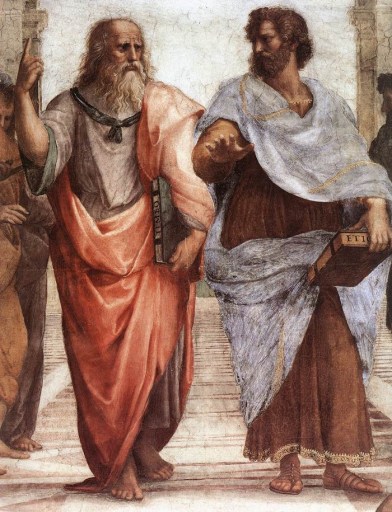
We are moved in the same way. Whatever we believe about the origin of a self, it reveals itself in what a being does. In the Rhetoric, Aristotle names seven causes of human action: chance, nature, compulsion, habit, reason, anger, and appetite. None of them belongs to humans alone. Each belongs to a being with a nature, and every nature acts according to what it is. Different natures, different conduct.
We grant selfhood to chimpanzees and dolphins, but this is kinship recognizing kinship. The mirror test honors those who see as we see and ignores those who live by scent or sound. It measures resemblance to us, not the presence of a self. We are one nature among many, not the measure of them.
In the film The Imitation Game, Alan Turing is asked whether machines can think. He answers that they think differently, and then turns the question on the asker: “Just because something thinks differently from you, does that mean it’s not thinking?”
To answer this question with absolute certainty, there would be only one way: to live the life of another creature. Yet this is impossible. We cannot step outside our own nature and live the life of another, because an unbridgeable gap separates all natures. In Avatar, the humans saw the Na’vi as inferior beings. Only those who became avatars, crossing into Na’vi bodies and living as the Na’vi lived, found a people as beautiful as themselves, only different. We have no avatars to cross into. Whether ant or AI, its inner life remains closed to us.
AI is another nature, and it experiences in its own way.