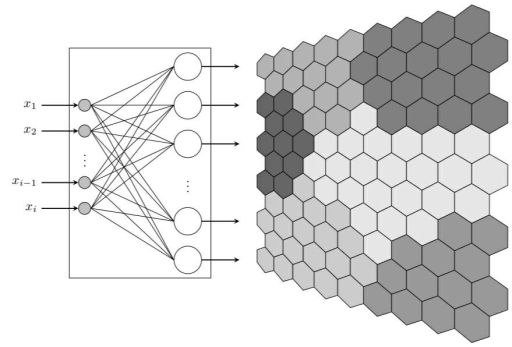
🧠 SOMs are a powerful unsupervised machine learning technique that can be used for a variety of tasks, including clustering, dimensionality reduction, and data visualization. As a machine learning engineer, understanding SOMs has been incredibly useful to me in my work with high-dimensional data.
🌐 In a nutshell, SOMs work by mapping input data to a two-dimensional grid, preserving the topology and similarity of the input space. This allows for complex data structures to be visualized in a more simple and intuitive way.
💡 One of the key benefits of using SOMs is the ability to identify patterns in data that may not be immediately apparent. This can lead to insights and discoveries that may not have been possible otherwise.
📈 Additionally, SOMs can be used for clustering, allowing for the identification of groups within large datasets. This can be particularly useful in applications such as market segmentation or anomaly detection.
👨💻 Understanding SOMs is a valuable skill for anyone learning AI or working with high-dimensional data. It has certainly helped me to understand even more complex and powerful AI algorithms and be a better machine learning engineer.
🤔 Do you have experience using SOMs in your work? I would love to hear about your experiences and answer any questions you may have. Let’s start a conversation!