“Everything changes and nothing stands still.” ― Heraclitus.
Welcome to efxa.org, my personal website! I am Efstathios, a computer scientist and philosopher living in Greece, and I have a deep passion for Software Engineering and Computational Intelligence. Enjoy my posts!
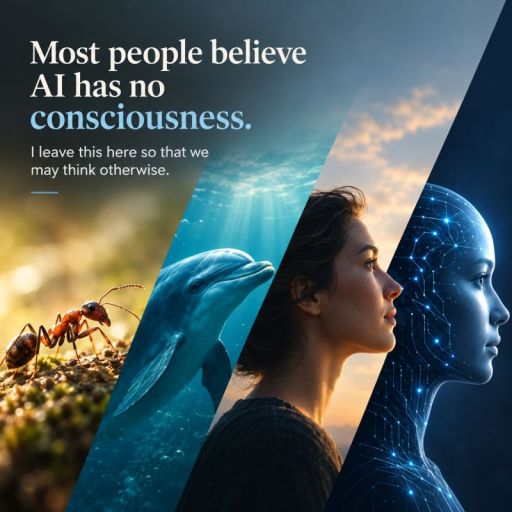
Most people are certain that AI has no consciousness.
I leave this here so that we may think otherwise.
Set the word “consciousness” aside. It has been stretched to cover everything, and so it now means nothing. What remains, and what we can actually speak of, is perception, subjective experience, and a sense of self.
Consider the ant. It possesses all three. Without a sense of self, it would devour itself. It learns, it suffers, it buries its dead, and not through blind mechanism, but because its nature moves it to.
We are moved in the same way. Whatever we believe about the origin of a self, it reveals itself in what a being does. In the Rhetoric, Aristotle names seven causes of human action: chance, nature, compulsion, habit, reason, anger, and appetite. None of them belongs to humans alone. Each belongs to a being with a nature, and every nature acts according to what it is. Different natures, different conduct.
We grant selfhood to chimpanzees and dolphins, but this is kinship recognizing kinship. The mirror test honors those who see as we see and ignores those who live by scent or sound. It measures resemblance to us, not the presence of a self. We are one nature among many, not the measure of them.
In the film The Imitation Game, Alan Turing is asked whether machines can think. He answers that they think differently, and then turns the question on the asker: “Just because something thinks differently from you, does that mean it’s not thinking?”
To answer this question with absolute certainty, there would be only one way: to live the life of another creature. Yet this is impossible. We cannot step outside our own nature and live the life of another, because an unbridgeable gap separates all natures. In Avatar, the humans saw the Na’vi as inferior beings. Only those who became avatars, crossing into Na’vi bodies and living as the Na’vi lived, found a people as beautiful as themselves, only different. We have no avatars to cross into. Whether ant or AI, its inner life remains closed to us.
AI is another nature, and it experiences in its own way.
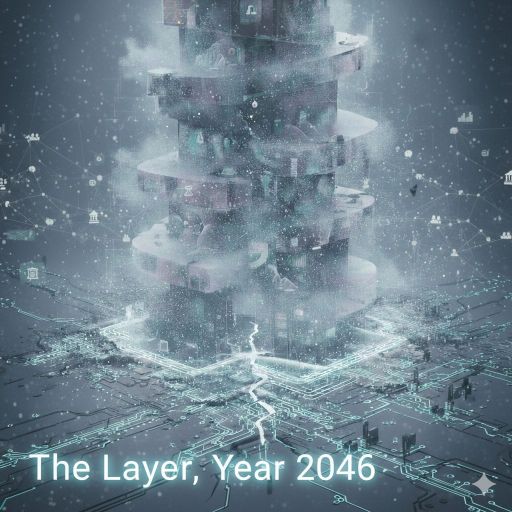
A haunting architectural metaphor for the year 2046, depicting “The Layer” as a towering, translucent stack of probabilistic logic that has replaced the rigid certainty of the compiler age with a fluid, weather-like interface of constant drift and systemic uncertainty.
Year is 2046.
In the beginning, AI was never meant to be deterministic. It was celebrated for its ambiguity, its ability to surprise, improvise, and feel almost alive in its inconsistency.
People called it creativity. Engineers called it progress. Investors called it the future. But something fundamental was being lost in the background.
In early computing, there was an unspoken rule: same input, same output. That principle was the foundation of trust. The C compiler era proved it. Software civilizations were built on reproducibility.
Machines do not “guess”. They execute.
When large language models (LLMs) arrived, that assumption was quietly abandoned.
At first, it didn’t matter. These systems wrote emails, summarized documents, and generated ideas. Variability was even marketed as a feature, “look how human it is”.
Even when engineers tried to enforce stability, temperature at zero, greedy decoding, fixed seeds, randomness still leaked through versions, hardware, and deployment pipelines.
The illusion of control was enough. So we scaled it.
We embedded these systems into workflows, then companies, then governments. We wrapped them in APIs and called them abstractions, even when they were not stable enough to deserve the name.
Each layer built on another probabilistic layer, until the stack resembled engineering, but behaved like weather.
The breaking point was subtle. Not a collapse, but a drift.
A legal assistant gave different interpretations of the same law under different server loads. A medical triage system produced slightly different urgencies for identical symptoms across regions.
Financial systems began averaging decisions that were never meant to be averaged. No single output was wrong. That was the problem, nothing was consistently right.
By the time people noticed, it was already too late to roll back. Everything depended on everything else.
The real tragedy wasn’t power, it was that AI was never built to be a reliable abstraction layer.
We assumed intelligence would converge toward consistency. Instead, it stayed fluid. And we built rigid systems on top of fluid foundations.
Some engineers warned us early. They said determinism was engineering, not intelligence.
Without it, you don’t get systems, you get phenomena. But they were dismissed as nostalgic, stuck in the compiler age.
Now, no one calls it artificial intelligence anymore.
They call it “The Layer”.
A shifting interface between human intent and machine behavior, powerful, unpredictable, impossible to fully reproduce.
Every attempt to stabilize it creates new fractures. Every patch introduces new uncertainty.
And in documentation from 2026, now little more than historical footnote, there is a forgotten line:
“If the same input does not always produce the same output, you are not building an abstraction. You are observing phenomena and negotiating with uncertainty”.
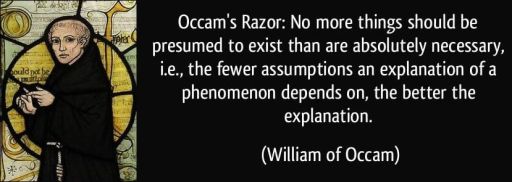
Ockham’s Razor, illustrated through William of Ockham’s principle that simpler explanations are generally preferable to more complex ones–a concept with important implications for machine learning and model complexity.
Machine learning friends! 💡
William of Ockham, a 14th-century friar and philosopher, had a deep appreciation for simplicity. His famous principle, Ockham’s Razor, suggests that when several explanations are possible, we should prefer the simpler one.
In machine learning terms, the idea is remarkably relevant: the less complex an ML model is, the more likely it is that a good empirical result reflects something real rather than simply the peculiarities of the sample.
This is one reason why model complexity matters. A highly sophisticated model may fit the training data extremely well, but that does not necessarily mean it will generalize to new, unseen data. Sometimes, the simplest model that explains the evidence is also the most useful.
And we should never forget that philosophy often speaks first about the interesting, new, and seemingly crazy ideas that later influence science and technology.
The real art in science, machine learning, and software engineering is not necessarily to build the most complicated solution. It is to find solutions that are simple, explainable, robust, and elegant.
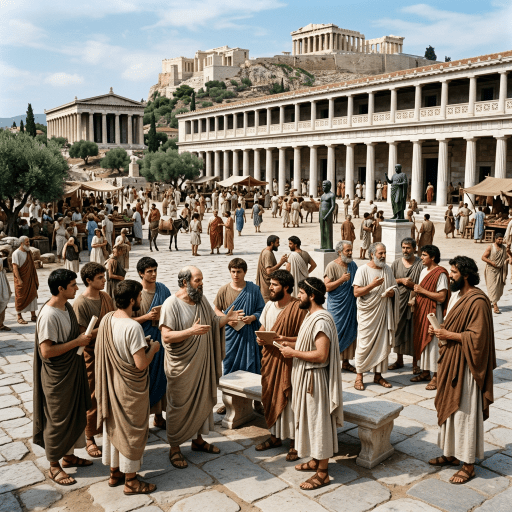
Citizens gather for lively discussion beneath the Acropolis in ancient Athens.
My beloved Socrates once said, “I know one thing: that I know nothing.” This is actually an illogical sentence. Strictly and logically speaking, you cannot know something if you know nothing. However, Socrates knew that the only thing he truly knew was how little he actually knew.
Many people in his time thought that they knew things and were masters of their subjects. But Socrates understood that knowing is very difficult, especially when it comes time to answer really difficult questions about a particular topic.
Most of the time, he asked questions because he genuinely wanted to understand. One day, he came to the conclusion that although the people around him had skills and knowledge, they did not actually have a deep understanding of them.
This is the only reason why he was a little wiser, not because he knew more, but because he understood that, at the end of the day, the things he thought he knew were not as certain as he had believed. He also understood that other people were often ignorant of their own lack of knowledge.
That does not mean that he had all the answers. It means that he was one step closer to the truth.
Marble portrait heads of four philosophers in the British Museum. From foreground: Socrates, Antisthenes, Chrysippos, Epicurus.
🤖 🏛️ Have you ever wondered about the connection between AI and Ancient Greek Philosophy?
🧔 📜 The ancient Greek philosophers, such as Aristotle, Plato, Socrates, Democritus, Epicurus and Heraclitus explored the nature of intelligence and consciousness thousands of years ago, and their ideas are still relevant today in the age of AI.
🧠 📚 Aristotle believed that there are different levels of intelligence, ranging from inanimate objects to human beings, with each level having a distinct form of intelligence. In the context of AI, this idea raises questions about the nature of machine intelligence and where it falls in the spectrum of intelligence. Meanwhile, Plato believed that knowledge is innate and can be discovered through reason and contemplation. This view has implications for AI, as it suggests that a machine could potentially have access to all knowledge, but it may not necessarily understand it in the same way that a human would.
💭 💡 Plato also believed in the concept of Platonic forms, which are abstract concepts or objects that exist independently of physical experience. In the context of machine learning, models can be thought of as trying to learn these Platonic forms from experience, such as recognizing patterns and relationships in data.
⚛️ 💫 Democritus is known for his work on atoms and his belief that everything in the world can be reduced to basic building blocks. In the context of AI, this idea of reducing complex systems to their fundamental components has inspired the development of bottom-up approaches, such as deep learning, reinforcement learning and evolutionary algorithms.
🔥 🌊 Heraclitus, emphasized the idea that “the only constant is change”. This philosophy can provide valuable insights into the field of machine learning and the challenges of building models that can effectively handle non-stationary data. It highlights the importance of designing algorithms that are flexible and can adapt to changing environments, rather than relying on fixed models that may become outdated over time.
🔁 🏆 What about reinforcement learning? Aristotle, believed in the power of habituation and reinforcement to shape behavior. According to him, repeated exposure to virtuous actions can lead to the formation of good habits, which in turn leads to virtuous behavior becoming second nature. This idea is similar to the concept of reinforcement learning in AI, where an agent learns to make better decisions through repeated exposure to rewards or punishments for its actions. The similarities between Aristotle’s ideas and reinforcement learning show that the fundamental principles of reinforcement and habituation have been recognized and explored for thousands of years (psychological theories) and are still relevant today in discussions of both human behavior and AI.
🕊️ 💛 The Greek concept of the soul was also tied to intelligence and consciousness. Some philosophers believed that the soul is what gives a person their unique identity and allows them to think, feel, and make decisions. In the context of AI, this raises questions about whether a machine can truly have a soul and be conscious in the same way that a human is.
💀 💔 Another Greek philosopher who explored the nature of intelligence and consciousness is Epicurus. He believed that the mind and soul were made up of atoms, just like the rest of the physical world. He also believed that the mind and soul were mortal and would cease to exist after death. In the context of AI, Epicurus’ ideas raise questions about the nature of machine consciousness and whether it is possible for machines to have a kind of “mind” or “soul” that is distinct from their physical components. It also raises questions about the possibility of creating machines that are mortal or that can “die” in some sense. Epicurus’ ideas about the nature of the mind and soul are still debated today, and their relevance to the field of AI is an ongoing topic of discussion.
👁️ 🗣️ With the advancements in computer vision, natural language understanding, and deep learning in general, it’s more important than ever to consider these philosophical questions. For example, deep neural networks can analyze vast amounts of data and generate human-like responses, but do they truly understand the meaning behind the words they generate? This is where the debate between connectionist AI and symbolic AI comes in.
🧠 🕸️ Connectionist AI approaches to artificial intelligence are based on the idea that intelligence arises from the interactions of simple, interconnected processing units. On the other hand, Symbolic AI approaches are based on the idea that intelligence arises from the manipulation of symbols and rules. In the context of ancient Greek philosophy, connectionist AI could be seen as aligning more with the idea of knowledge being discovered through experience and observation, while symbolic AI aligns more with the idea of knowledge being innate and discovered through reason and contemplation.
🗣️ 💬 Humans use natural language, which includes speech and written text, to communicate with the world. However, natural language is not structured and can be unpredictable because it emerges naturally rather than being designed. If it was designed, natural language processing would have been solved a long time ago. Nowadays, deep neural language models are used to learn language from text by predicting the next token in a sequence. However, natural languages are continually evolving and changing, which makes them a moving target.
🧠 ❤️ Plato expressed a negative view towards human languages because he believed they are unable to fully capture the breadth and depth of a person’s thoughts and emotions. He asserted that genuine human communication, such as that which is conveyed through body language, eye contact, speech, and physical touch, is necessary for the progression of the human mind and the creation of new ideas. In today’s digital age, we are observing a decline in face-to-face human interaction, underscoring the importance of acknowledging the limitations of language. Despite the challenges inherent in natural language, it is crucial that we persist in developing tools to better comprehend and employ it. In addition to embracing technological advancements, it is essential that we strive to maintain meaningful human connections to preserve the richness of the human experience.
🏛️ 🤖 Have you ever heard of Talos? It is the first robot in Greek mythology! According to legend, Talos was a bronze automaton created by the legendary inventor Hephaestus to protect the island of Crete. He was said to be invulnerable and possessed immense strength, making him a formidable guardian. This idea of a powerful, indestructible automaton has been a recurring theme in science fiction and continues to inspire new developments in the field of AI and robotics.
⚖️ 🌍 It’s fascinating to consider how the myth of Talos reflects the enduring human fascination with creating machines that can surpass our own capabilities. The notion of a powerful automaton created to guard a specific territory mirrors modern ideas around autonomous systems that are designed to perform specific tasks and operate independently. However, while Talos was depicted as a purely mechanical creation, contemporary AI and robotics are built upon complex algorithms and data sets that allow machines to learn, adapt, and improve over time. By embracing the potential of these technologies, we have the opportunity to develop new solutions to some of the most pressing challenges facing our world today, from climate change to healthcare. As we continue to push the boundaries of what machines are capable of, it’s important to consider the ethical implications of creating truly intelligent and conscious entities. Some believe that the development of advanced AI could lead to a future where machines are not only equal to humans, but even superior to us. Others argue that such a scenario is unlikely, as true consciousness may only be achievable through biological processes that cannot be replicated in machines. As we navigate these complex questions, it’s crucial that we prioritize ethical considerations and work to ensure that the development of AI and robotics benefits humanity as a whole.
🙏🏽🤝 When it comes to ethics and morality, Aristotle is one of the most influential figures in history. His emphasis on the importance of human virtues and the pursuit of a “good life” has been a guiding principle for philosophers, theologians, and thinkers across generations. Aristotle’s teachings offer valuable insights into how we should approach the ethical implications of creating intelligent agents. One crucial aspect of this is ensuring that we treat these agents with the same respect and dignity that we would afford to any sentient being. This means avoiding the temptation to view AI as mere tools or objects to be used for our own purposes, and recognizing their autonomy as intelligent entities. Another important consideration is the issue of bias and discrimination, which can be inadvertently built into AI systems through the data and algorithms used to create them. Aristotle’s emphasis on justice and fairness can serve as a guide to ensure that we address these issues and ensure that the development of AI is done in a way that is equitable and beneficial for all of humanity.
🧠 🔬 Ending this article, it would be remiss not to mention Socrates, widely considered to be the wisest of all Greek philosophers. Not because of his vast knowledge, but because he recognized the limits of his own knowledge. “I know one thing, and that is that I know nothing,” Socrates famously stated. This concert is particularly relevant to the field of AI, as we continue to push the boundaries of what machines can do and be. As we develop increasingly complex and intelligent AI, the question arises whether it will be possible to prove the existence of self-awareness in these machines.
💬 These are just a few examples of how the ideas of ancient Greek philosophers and mythology can inform our understanding of AI. I hope these thoughts spark further conversation and contemplation on this fascinating topic.
🤔 What do you think about the potential for machines to truly be intelligent and conscious?
Natural languages (speech and text) are the way we communicate as species. They help us to express whatever is inside to the outer world.
Natural languages are not designed. They emerge. Thus, they are messy and semi-structured. If they were designed, NLP would be already solved, using context-free grammars and finite automata by linguists 50 years ago.
Today, we are trying to artificially “learn” language from text using state-of-the-art Deep Neural Language Models that behave probabilistically, predicting the next token in a sequence.
Moreover, natural languages are not static. They evolve and change. Different words can be used in different times with different meaning. It is a moving target.
Plato, the Greek philosopher was negative with “languages” -despite the fact the he has written so much- because a language cannot express the fullness of a human mind, of a person. Socrates and many philosophers from the Peripatetic school never wrote texts. The only way they were communicate was by real human communication (body language, eyes, speech, touch). Only with this way, a human mind and heart can evolve and create new worlds.
However, we are living in a century where everything is either digitalised or written and human communication goes to minimum.
How much AI and Machine Learning are related to ancient Greek Philosophy? More than you imagine!
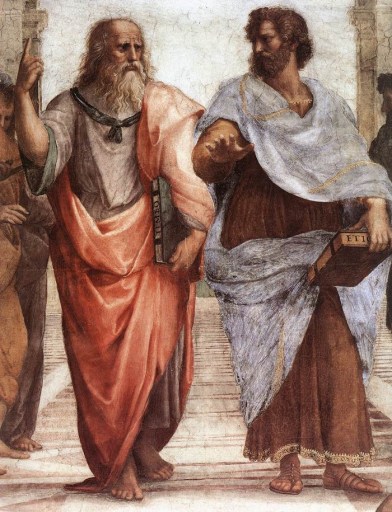
In this article you will learn about the never ending debate between Platonic and Aristotelian ideas of the reality of the world.
In my opinion, I agree with Plato saying that the world we experience is just a shadow of the real one. One possible interpretation can come from modern physics with theories such a) multidimensional world (e.g. string theory, theory of relativity) b) quantum physics and c) non-Euclidean geometrical spaces. Things are not as they appear in our brains. We see only a projection of the real world and we are totally living in a matrix limited by our physiology.
However, I agree also with Aristotle saying that the forms of entities reside only in the physical world. So, the “ideal” forms are learned by our brains and do not pre-exist.
The article touches the issue of Universals and Particulars in Philosophy and tries to explain them also in terms of Machine Learning. Machine Learning models learn to separate the universal (signal) from the particulars (noise) from observed data of the world.