🤔 What is it?
LWR is a non-parametric regression technique used in machine learning to model the relationship between a dependent variable and one or more independent variables. It is ideal for non-linear relationship modeling between variables as it does not assume a specific functional form. LWR is memory-based, storing the entire training dataset and making predictions based on the closest observations to the new data point. Model parameters are computed individually for each new data point, allowing for more customized and accurate predictions. It has applications in finance, economics, ecology, engineering, and can be used for time-series forecasting, data smoothing, and data imputation.
🕵️♂️ How does it work?
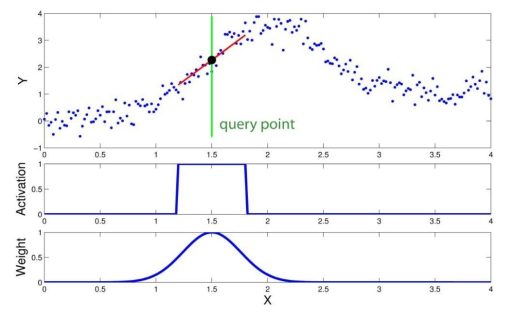
To estimate the dependent variable for a new data point, LWR fits a line to the nearest observations in the training data. The weight given to each observation is determined by its distance from the new data point, with closer observations receiving higher weights. For each new data point, LWR estimates a Gaussian distribution for the closest observations and uses it to fit a line for prediction. The Gaussian distribution is used to estimate the weights of examples in the cost function of LWR.
👨💻 My personal experience
As a machine learning engineer, I have found LWR to be an effective technique for modeling non-linear relationships between variables and handling noisy data, which has led to improved accuracy in my predictions. I believe that LWR is an essential technique to have in your toolkit as you learn and develop your skills in AI and machine learning.
🤔 Why is it useful?
LWR is valuable for modeling complex, non-linear relationships between variables and handling outliers and noise in data. Since it is memory-based, LWR does not require a pre-defined model structure and can adapt to new data easily. Additionally, it can be used for both single-variable and multi-variable regression problems, making it a versatile tool for a range of applications.
📚 Who should learn it?
LWR is a valuable technique for anyone working on regression problems, particularly those with non-linear relationships between variables or noisy data. It can help improve prediction accuracy and handle outliers and other sources of noise in data. If you are interested in machine learning and AI, I highly recommend learning LWR as part of your toolkit.
🗣️ Let’s start a conversation!
Have you used LWR in your work? What are your thoughts on this technique? Do you have any questions or comments? Let’s start a conversation in the comments below!