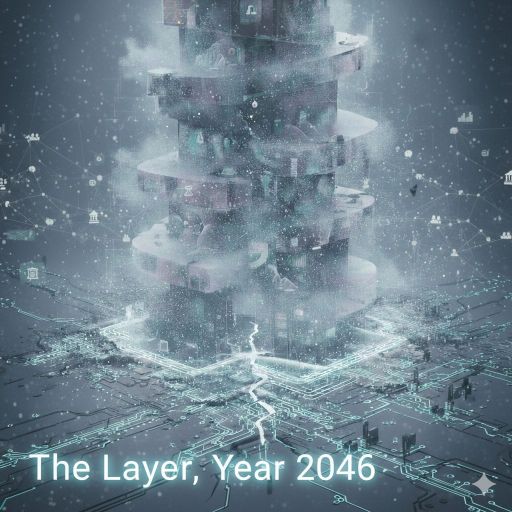
Year is 2046.
In the beginning, AI was never meant to be deterministic. It was celebrated for its ambiguity, its ability to surprise, improvise, and feel almost alive in its inconsistency.
People called it creativity. Engineers called it progress. Investors called it the future. But something fundamental was being lost in the background.
In early computing, there was an unspoken rule: same input, same output. That principle was the foundation of trust. The C compiler era proved it. Software civilizations were built on reproducibility.
Machines do not “guess”. They execute.
When large language models (LLMs) arrived, that assumption was quietly abandoned.
At first, it didn’t matter. These systems wrote emails, summarized documents, and generated ideas. Variability was even marketed as a feature, “look how human it is”.
Even when engineers tried to enforce stability, temperature at zero, greedy decoding, fixed seeds, randomness still leaked through versions, hardware, and deployment pipelines.
The illusion of control was enough. So we scaled it.
We embedded these systems into workflows, then companies, then governments. We wrapped them in APIs and called them abstractions, even when they were not stable enough to deserve the name.
Each layer built on another probabilistic layer, until the stack resembled engineering, but behaved like weather.
The breaking point was subtle. Not a collapse, but a drift.
A legal assistant gave different interpretations of the same law under different server loads. A medical triage system produced slightly different urgencies for identical symptoms across regions.
Financial systems began averaging decisions that were never meant to be averaged. No single output was wrong. That was the problem, nothing was consistently right.
By the time people noticed, it was already too late to roll back. Everything depended on everything else.
The real tragedy wasn’t power, it was that AI was never built to be a reliable abstraction layer.
We assumed intelligence would converge toward consistency. Instead, it stayed fluid. And we built rigid systems on top of fluid foundations.
Some engineers warned us early. They said determinism was engineering, not intelligence.
Without it, you don’t get systems, you get phenomena. But they were dismissed as nostalgic, stuck in the compiler age.
Now, no one calls it artificial intelligence anymore.
They call it “The Layer”.
A shifting interface between human intent and machine behavior, powerful, unpredictable, impossible to fully reproduce.
Every attempt to stabilize it creates new fractures. Every patch introduces new uncertainty.
And in documentation from 2026, now little more than historical footnote, there is a forgotten line:
“If the same input does not always produce the same output, you are not building an abstraction. You are observing phenomena and negotiating with uncertainty”.